
-
Automotive Parts Cost FAQ: What I Learned Tracking $180K in 6 Years
-
1. How much does it really cost to replace a timing belt?
-
2. Timing belt or timing chain — which actually costs less over 100,000 miles?
-
3. Is a Febi Bilstein timing chain kit good enough, or do you need OEM?
-
4. When should a suspension strut assembly be replaced — and does the brand matter?
-
5. Used headlight assembly vs. new — when is used actually smart?
-
6. Is a 2-inch muffler upgrade worth it, or are you just paying for sound?
-
7. What's the hidden cost nobody budgets for?
-
1. How much does it really cost to replace a timing belt?
Automotive Parts Cost FAQ: What I Learned Tracking $180K in 6 Years
I'm the procurement manager at a 120-person construction logistics company. We run about 45 vehicles — mostly pickups, box trucks, and a handful of SUVs. Over the past six years, I've logged every parts and labor invoice in our cost tracking system. Cumulative spend: roughly $180,000.
When people ask what car parts cost, they usually want the sticker price. That's the wrong number. Here are the seven questions I actually get asked, with the numbers behind them.
1. How much does it really cost to replace a timing belt?
Most shops quote $500–$1,100 for the belt, tensioner, water pump (usually bundled), and labor. That's the visible cost. What nobody mentions upfront: the "while-you're-in-there" items that push the total to $800–$1,500 on most modern engines.
We had one case where an independent shop quoted $625 and the dealership quoted $980. I picked the cheaper option. Final invoice came in at $870 — the tensioner "wasn't included," and the water pump "looked worn." Looking back, we never actually confirmed it was worn. We just paid.
My rule now: budget 30% above the lowest quote. That's closer to the real price.
2. Timing belt or timing chain — which actually costs less over 100,000 miles?
This one kept me up for two weeks (this was back in 2023, when we were setting service intervals for a batch of new trucks).
On paper, timing chains win. They're designed to last the life of the engine, no scheduled service. Timing belts need replacement every 60,000–100,000 miles, which runs $600–$1,200 per vehicle.
But chains fail too — usually from a stretched chain, a bad tensioner, or sludged oil. When they fail, they tend to fail catastrophically ($2,500+ in engine damage). Belts fail predictably. You know when one is due.
Which is cheaper? Depends on maintenance discipline. If drivers skip oil changes, choose the belt. Predictable repairs beat unpredictable ones every time.
3. Is a Febi Bilstein timing chain kit good enough, or do you need OEM?
Real argument we had over a 2018 pickup we run hard. Supplier offered the Febi Bilstein kit at ~$280 vs. OEM at $470.
My take: for a vehicle still under manufacturer warranty, use OEM. For out-of-warranty vehicles, a known aftermarket brand is fine — but check that the tensioner is included and look at who actually made the chain, not just the brand on the box.
The failures I've seen weren't the chain itself. They were the tensioners and guides. Cheap parts, expensive damage.
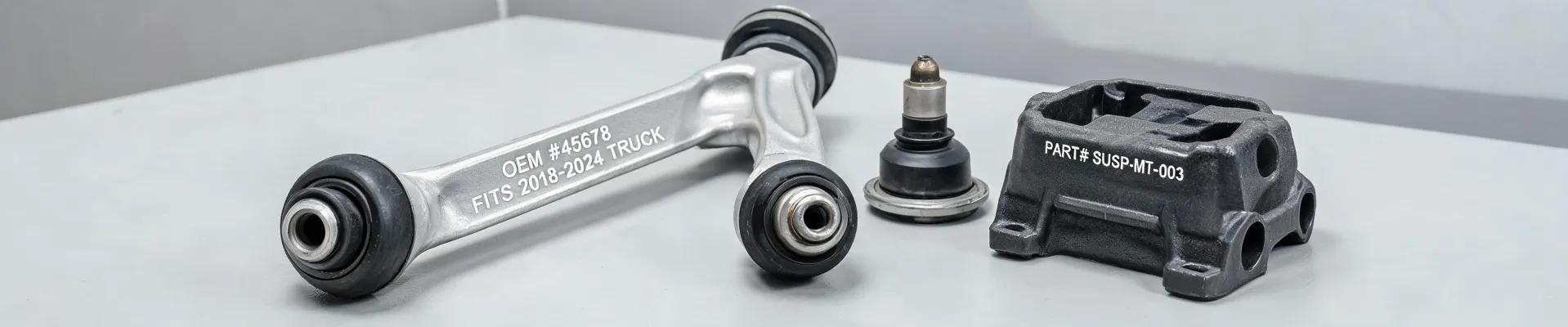
4. When should a suspension strut assembly be replaced — and does the brand matter?
Common guidance: 50,000–100,000 miles. My real-world trigger: when the vehicle starts wandering on the highway or cupping tires.
We tested a Bilstein B6 performance strut assembly against a mid-tier OEM replacement on two identical trucks. The Bilstein lasted 92,000 miles before we noticed degradation. The mid-tier started failing around 58,000. The Bilstein cost about $210 more per corner. It delivered 34,000 more miles. That's roughly $0.006 per mile in favor of the higher-priced part.
Sticker prices lie about this. You have to do the math per mile.
5. Used headlight assembly vs. new — when is used actually smart?
For a fleet, used headlight assemblies make sense in two cases:
- The vehicle is being retired in under 18 months
- The exact OEM part is discontinued
Everywhere else, buy new. A used headlight is a moisture trap waiting to fail. We bought four used units in 2022 at $90 each. Two fogged up within a year. The replacement labor is the same whether the part cost $90 or $400 — that's the number that wrecks the "savings."
Total on the four "cheap" used units: $360 parts + $680 labor + $740 for the two replacements = $1,780. Four new ones would have run $1,600 installed.
Used isn't wrong. Run the labor math first.
6. Is a 2-inch muffler upgrade worth it, or are you just paying for sound?
Depends on the use case. For a work pickup, a 2-inch muffler can marginally reduce backpressure and sharpen throttle response. For a passenger car, you're buying sound, not performance.
The hidden cost is compliance. Some jurisdictions ticket aftermarket exhausts. And on resale, an aftermarket exhaust sometimes hurts value more than it helps.
My rule when it's company money: upgrade the muffler only when the original is being replaced anyway. Don't create a repair to justify an upgrade.
7. What's the hidden cost nobody budgets for?
Downtime.
Every hour a work truck sits off the road costs us $85–$120 in lost productivity. Last year we compared two quotes for the same job — $510 with a 2-day turnaround vs. $580 same-day. The $70 "saving" evaporated the moment the truck sat idle for an extra day.
If your cost spreadsheet doesn't have a downtime column, it isn't a TCO spreadsheet. It's a wishlist.
That's the one thing I'd tell anyone getting into automotive parts procurement: the invoice is the smallest number in the file.

Elise Novak
Elise Novak is an automotive braking systems analyst specializing in brake pads, discs, rotors, calipers, shoes, drums, hoses, and complete brake kits. She uses UN Regulation 90 requirements and ISO 26867 dynamometer methods to examine friction stability, fade and recovery, wear, disc thickness variation, runout, and hydraulic integrity. Her work helps distributors, quality teams, and fleet buyers compare replacement parts, verify application suitability, and define incoming-inspection criteria.
Leave a sourcing comment