If you're searching for a Bilstein B4 front air strut for the 2012-15 ML350, or a Bilstein 8125 series shock absorber, you're in the wrong place. But if you're sourcing stamped brackets, aluminum housings, or CNC-machined parts, keep reading. I've handled purchasing on the metal parts side since 2017, and I've made and documented enough mistakes to fill a scrap bin. This FAQ is the plain-language checklist I wish I'd had before my first big order.
Here's what we'll cover:
- Are you the Bilstein suspension company?
- What does bilstein actually manufacture?
- What's the biggest mistake when ordering stamped metal parts?
- What should I look for in a leaf spring company?
- How much is a camshaft position sensor?
- Can you make a thermostat housing?
- What is PPAP and why should a small buyer care?
- What's your honest advice before placing a first order?
1. Are you the Bilstein suspension company?
No, and I'm glad you checked before ordering. There's a well-known suspension brand with a similar name — the company behind the Bilstein B4 front air strut for the 2012-15 ML350 and the 8125 series shock absorber. That's not us, and we're not affiliated. We're bilstein, a B2B metal parts supplier for automotive components: stampings, progressive dies, CNC machining, forging, and aluminum extrusions. If you came here for dampers or struts, you want the suspension people. If you need metal components for production, you're in the right place.
2. What does bilstein actually manufacture?
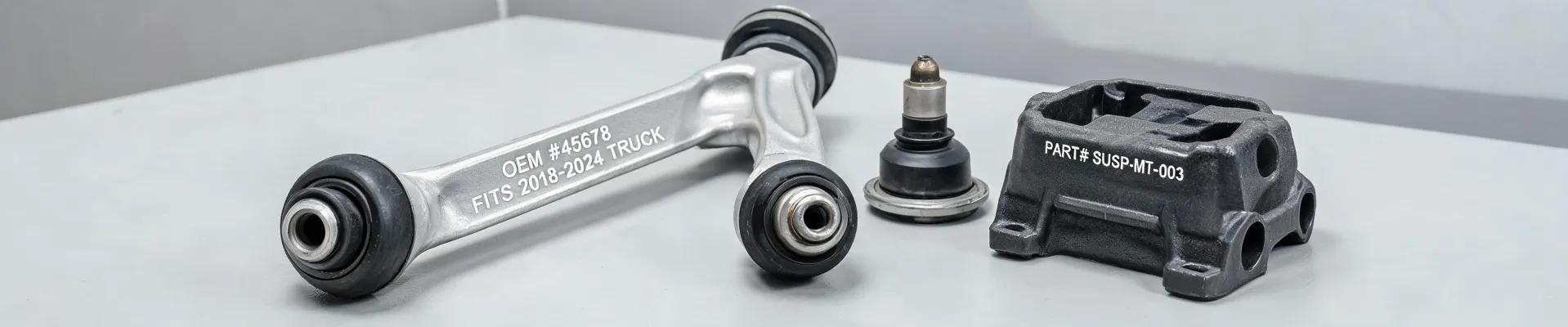
Most of our work is B2B: stamped brackets, mounting plates, sensor housings, battery trays, and small structural parts. We build progressive dies in-house, which matters because tooling decides whether parts stay consistent across a production run. Add CNC machining and aluminum extrusion, and a single supplier can handle a surprisingly large chunk of a metal part program. That said, we don't try to be everything to everyone — no soft trim, no electronics, no finished leaf springs. Knowing exactly where a supplier's capabilities stop saves time because it kills the back-and-forth of false hope.
3. What's the biggest mistake when ordering stamped metal parts?
Sending over a drawing and assuming the supplier will read it the same way you do. I made that mistake in September 2022 on a 200-piece stamped bracket order. I approved the PO, skipped the material certificate check, and the parts looked fine on the surface. Then our customer did a simple bend test and the edges split like dry biscuits. Wrong grade of steel — $3,200 of scrap plus a one-week delay. That's when I started treating the material spec as a deal-breaker, not a formality. Now every RFQ includes the ASTM grade, surface finish, and PPAP level. It feels like paperwork until it saves you from a rejected shipment.
4. What should I look for in a leaf spring company?
Honestly, I don't sell leaf springs, but I've audited suppliers that do, and I've seen enough to know where the blind spots are. First, material traceability. Leaf springs carry serious load, and if the steel composition or heat treatment records aren't traceable, you're relying on hope. Second, fatigue testing. Ask how many cycles they run, at what load, and against which standard. If a supplier can't produce mill certificates or test reports, that's a red flag. To be fair, a small shop can make excellent springs after decades of practice. But if the process isn't documented, you can't prove it to your own customer. And in this parts game, proof is what keeps the order.
5. How much is a camshaft position sensor?
Anyone who gives you one flat number is guessing. As of early 2025, I've seen camshaft position sensors range from roughly $25 to $150 for the part itself, depending on OEM vs. aftermarket, plus the connector and metal housing. Labor is another 30 to 90 minutes on many engines because the sensor is buried under the intake. But here's the purchasing angle: the expensive part of a sensor is the electronics and calibration, not the housing. If you're sourcing the metal housing anyway, don't fixate on piece price alone. Focus on dimensional tolerance. A housing that's off by 0.1 mm can create sensor misalignment, a check-engine light, and a warranty claim that costs far more than the part saved.
6. Can you make a thermostat housing?
Yes, thermostat housings are a natural fit for our process because they're usually aluminum — either die-cast, extruded, then machined. From our side, a housing is a housing, whether it's for a thermostat or a sensor. The tricky part is sealing. We've seen customers order a housing that looks identical to the original but leaks because the flange surface finish wasn't specified. If you're cross-referencing a part like the Echo B thermostat, make sure the supplier knows the gasket style, torque spec, and whether the sealing face needs a specific flatness tolerance. We can make the housing; we just need the right data before cutting steel.
7. What is PPAP and why should a small buyer care?
PPAP stands for Production Part Approval Process, and it's basically a file of evidence that the parts will meet the spec. Small buyers often skip it because it feels like big-OEM bureaucracy. But even a Level 1 PPAP gives you signed material certificates, dimensional reports, and process verification. We've caught 47 potential errors with our pre-order checklist in the past 18 months, and most were caught because one person asked one extra question before tooling started. If a supplier pushes back on documentation, treat that as a warning sign. The upfront work feels slow, but a rejected shipment is slower.
8. What's your honest advice before placing a first order?
Ask for PPAP level, material certificates, and samples before the production run. Trust me on this one. The time to find a quality problem is before steel is cut, not after it's painted and packed. Bottom line: quality is how customers judge you. One part with a visible crack or a scratch says more about your company than any spec sheet. If you're thinking about saving a few dollars on cheaper materials, don't. The savings disappear the first time a customer's inspector rejects a batch. I've only worked with mid-sized orders, so your experience may differ, but the basics hold up: document everything, verify everything, and treat quality as the brand, not the extra.

Elise Novak
Elise Novak is an automotive braking systems analyst specializing in brake pads, discs, rotors, calipers, shoes, drums, hoses, and complete brake kits. She uses UN Regulation 90 requirements and ISO 26867 dynamometer methods to examine friction stability, fade and recovery, wear, disc thickness variation, runout, and hydraulic integrity. Her work helps distributors, quality teams, and fleet buyers compare replacement parts, verify application suitability, and define incoming-inspection criteria.
Leave a sourcing comment