-
Who This Checklist Is For
-
1. Confirm the Exact Part. Not a Description—a Number
-
2. Run the VIN Through the Right Lookup
-
3. Know the Specs That Determine Failure or Success
-
4. Check Stock and Delivery Windows Before You Drive Anywhere
-
5. Calculate Total Cost, Not Just the Listed Price
-
6. Have a Manufacturing Backup for Parts That No Longer Exist
-
Final Checks and Common Mistakes
In my role coordinating rush parts for automotive repair shops and manufacturers, I've learned that emergency orders are a different game. Normal lead times go out the window. The customer doesn't care about the process—they care about the hour the part actually lands on the bench.
This checklist is what I run through when I'm triaging a rush order. It took me about five years and more than 200 urgent jobs to build it. At bilstein, we see the metal side of this—mounting brackets, housings, and small production runs when the original part is discontinued. But the logic below applies to any part.
Who This Checklist Is For
If you're a fleet manager, a workshop owner, a solo mechanic, or a buyer who's ever had to explain why a vehicle is still in the bay three days later, this is for you. It also works if you're on the other side—a manufacturer or distributor trying to deliver parts under a hard deadline. No theory here. These are the checks we use before committing to any delivery.
1. Confirm the Exact Part. Not a Description—a Number
Every rush order starts with the same problem: vague language. 'I need a suspension shock' doesn't help. Neither does 'some fuel pump.' You need the OEM number, a part photo, or at minimum the vehicle's VIN and engine code.
Take a search like 'bilstein b8 8100 suspension shock.' It sounds specific, but the B8 8100 line includes different reservoir configurations and valving for different vehicles. The same model number might not physically fit a lifted Jeep versus a stock truck. If the customer doesn't have the part number off the old unit, I don't order anything.
A lot of buyers skip this step because they think the description is enough. It isn't. In the parts world, 'compatible with' can mean anything from exact OEM fit to you'll need a torch, a drill, and maybe a good lawyer.
Bottom line: part number first. Description second. The VIN decides the rest.
2. Run the VIN Through the Right Lookup
If you're replacing a fuel pump or a rotor, the catalog on the parts store website may be enough. For suspension or anything safety-critical, use a VIN-based lookup and cross-reference with the factory numbers. I've seen a one-digit typo in a VIN turn an 'in-stock' fuel pump into a two-day wait because it was the wrong pump. That white F-150 you have? The 3.5L and 5.0L take different pumps even in the same model year.
Don't stop at one app, either. I usually cross-check the part number in two different catalogs and, for European vehicles, a decoding program. If the part number doesn't come back with the same vehicle application twice, stop. That mismatch is the first clue something is wrong.
Learn that one and you'll save more money than any discount code.
3. Know the Specs That Determine Failure or Success
This is where the technical judgment kicks in. For brake rotors, the minimum thickness in mm is stamped on the rotor hat. According to standard brake service practice, the rotor must be replaced if it's below that number, and it should be measured with a micrometer at the thinnest point—not in the center. Many passenger cars run new front rotors around 28-30 mm with a minimum of 26-28 mm. Rear rotors are often 10-12 mm new with a minimum of 8-9 mm. But I've seen trucks with much thicker rotors. The stamped number is the only spec that matters.
Can a bad alternator drain a battery? Yes. It's one of the most common parasitic drain causes. A shorted diode allows current to flow from the battery through the alternator even with the ignition off. When I'm triaging an electrical problem, the first thing I do is a draw test. If the reading is over 50 milliamps with everything off, I disconnect the alternator. If the draw disappears, the alternator is the problem. Install the new alternator, then retest—because if it still draws, you're chasing another component.
For fuel pumps, the key specs are pressure and flow rate. A pump that dumps too much pressure can flood a returnless system, and one that's weak will make a car run lean or stall under load. The VIN and engine code will narrow that down, but confirm with the original pump's label if you can reach it.
For the suspension pricing side of the world, the 'Bilstein suspension price' is often the last thing I look at. First, I look at travel, reservoir orientation, hose routing, and spring seat height. Get those wrong and the shock is a paperweight regardless of the price.
4. Check Stock and Delivery Windows Before You Drive Anywhere
When a shop guy says 'fuel pump near me,' he's usually imagining a 15-minute drive to a local parts store and a part on the counter. It doesn't always work that way. I've had a local store tell me they had a pump, then when I arrived, it was a reman for a different engine. I've also had a warehouse 300 miles away promise it by 5 pm and actually hit 4:47.
The only reliable move is to call ahead, have them check the physical bin, and get a name. Ask: 'Can you put your hands on it right now?' If they hesitate, that's a red flag. Time is the one thing you can't restock.
The best local supplier for general parts may not be the best for a specific pump. Sometimes the right part is 40 minutes away at a truck dealership, but nobody knows because everyone searched 'near me' instead of 'in stock anywhere.'
5. Calculate Total Cost, Not Just the Listed Price
This is where I see buyers make the most expensive mistake. They find the cheapest Bilstein suspension price on a marketplace and click buy. Then the vendor ships from a distribution center across the country, the part takes four days, and the vehicle sits in the bay all that time. The $80 you saved on the shock disappears the moment the rental car invoice comes in.
Same logic works the other way. I've paid $120 in overnight freight on a $90 part. It looked bad on paper. But it got a customer's vehicle back on the road for a job deadline, and that customer still sends us work. If you ask me, that was a no-brainer.
That's why more procurement teams use landed cost, not list price. Landed cost includes shipping, customs, warranty recovery, and downtime. It's a longer calculation, but it's the only honest one.
6. Have a Manufacturing Backup for Parts That No Longer Exist
Eventually, you'll hit a part that isn't on a shelf anywhere. A discontinued bracket, a prototype housing, a mounting plate for a modified suspension. That's not a parts problem—it's a manufacturing problem.
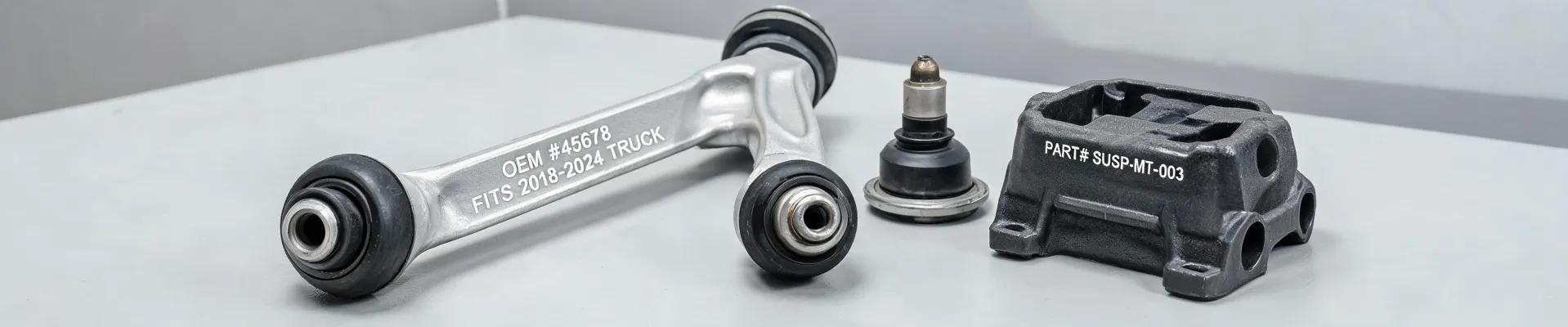
This is where bilstein fits. We're a multi-process automotive parts supplier. We design and build progressive dies in-house, then use stamping, CNC machining, forging, and aluminum extrusions to make parts. In March 2024, a client needed 40 mounting brackets for a prototype suspension system in 48 hours. Normal lead time was eight days. We pulled the base shape from an existing die, machined the final holes, and shipped with four hours to spare. The client's alternative was a two-week tooling wait and a missed prototype event.
If the volume is high enough to justify a dedicated die, progressive stamping can run thousands of pieces with consistent tolerances. For lower volumes, CNC machining or a hybrid of stamping and machining often makes more sense. Could we do that for every rush order? Probably not. But for metal parts that are geometrically close to something we've made before, a manufacturing bypass can be faster than trying to locate a part that no one makes anymore.
Final Checks and Common Mistakes
Before I place any rush order, I run a final pass through the same checklist:
- Never assume 'same specifications' means identical parts across vendors. I learned this after a vendor delivered a batch of brackets that looked right but had holes off by 0.75 mm. The drawing said 12.5 mm, the vendor interpreted it as 12.5 mm maximum, not a midpoint. Everything got rejected.
- Never skip the minimum thickness check. A rotor can look new and still be under the stamped spec.
- Always retest for parasitic draw after replacing the alternator. Replacing the part isn't the same as fixing the problem.
- Confirm whether 'bilstein' means the shock manufacturer or a metal parts supplier. If you're after shocks, call a suspension specialist. If you need custom metal parts for a vehicle, that's our lane.
One more thing: check your time buffer. If the vehicle needs to run by Friday, aim for Wednesday. The extra 48 hours will save you more times than I can count. That's the lesson from 200+ rush jobs—consistency, not heroics, is the real game-changer.

Elise Novak
Elise Novak is an automotive braking systems analyst specializing in brake pads, discs, rotors, calipers, shoes, drums, hoses, and complete brake kits. She uses UN Regulation 90 requirements and ISO 26867 dynamometer methods to examine friction stability, fade and recovery, wear, disc thickness variation, runout, and hydraulic integrity. Her work helps distributors, quality teams, and fleet buyers compare replacement parts, verify application suitability, and define incoming-inspection criteria.
Leave a sourcing comment