
There's no one right answer — it depends on your part
If you've ever had to source a metal bracket, a mounting plate, or a custom housing, you know the drill: you call a few shops, describe what you need, and hope they have the right process. But honestly, there's no universal "best" way to make a metal part. The right approach depends on volume, complexity, material, and — let's be real — your timeline.
I manage purchasing for a mid-size automotive supplier. We buy roughly $400K annually in metal parts across stamping, forging, and CNC machining. When I took over purchasing in 2020, I assumed one supplier could handle everything. That was naive. What I've learned is that matching the process to the part is the real skill. Here's how I think about it now.
Three common scenarios (and what they usually need)
Most of the parts we source fall into one of three buckets. I'll walk through each, explain what's worked for us, and point out where conventional wisdom gets it wrong.
Scenario A: High-volume, simple geometry — go with stamping
If you need 50,000+ pieces of a part that's basically flat or has simple bends — think brackets, mounting plates, clips — stamped parts are hard to beat. The unit cost drops dramatically once the die is made, and the consistency is excellent.
What I wish someone told me earlier: The die cost is the real decision point. I've seen quotes where the die alone was $8,000 for a progressive die (basically, a multi-step die that cuts and forms in one pass). That's fine if you're amortizing over 100,000 parts. But for a one-off run of 500? You'll never recover that tooling cost.
People think stamping is always the cheapest option. Actually, it's the cheapest per unit at high volume. The breakeven against CNC machining depends entirely on your quantity. I still kick myself for approving a stamping die for a part we only ended up ordering 3,000 of. The die paid for itself in year four — not exactly efficient.
Scenario B: Complex geometry, high strength, medium volume — forging or extrusion
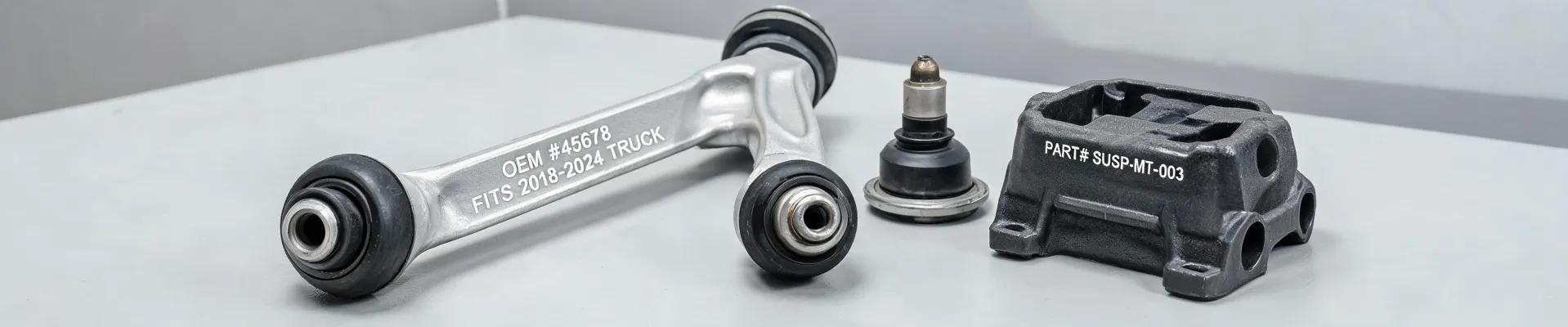
Our Tacoma TRD off-road suspension Bilstein components needed brackets that had to handle real stress — not just static load but vibration and fatigue. That's where forging or aluminum extrusion comes in.
Forging is great when you need the grain structure to follow the part shape. It's stronger than stamped or machined parts from bar stock. Downside? Die costs are higher ($10K–$20K for a set), and lead times are longer — usually 6–8 weeks for the die itself.
Aluminum extrusion shines for long, consistent cross-sections — think heat sinks, rails, or trim pieces. The die cost is lower (maybe $1,500–$3,000), but you're limited to parts that have a constant profile. You can't extrude a part that changes shape along its length.
(Honestly, I mix these up sometimes. I had to check with our engineering team to confirm which parts were forged vs. extruded on a recent project. Note to self: keep better documentation.)
Scenario C: Low volume, tight tolerances, complex features — CNC machining
For prototypes, small runs, or parts with features that can't be formed (like threaded holes on multiple faces), CNC machining is the go-to. No tooling cost, fast turnaround, and you can iterate the design quickly.
The trade-off? Per-part cost is higher. For a typical bracket that would cost $0.80 stamped, you might pay $8–12 for a CNC version. But for 50 parts, that's still cheaper than a $10,000 die.
Here's a mistake I made: I assumed CNC parts were always slower. In 2024, we had a rush order for a custom mounting bracket — needed 200 pieces in 10 days. The stamping shop quoted 6 weeks for tooling. A local CNC shop delivered in 8 days (including programming). The bottleneck wasn't machining; it was the tooling setup.
How to tell which scenario fits your part
If you're not sure where your part lands, here's a quick checklist I use:
- Annual volume: Over 10,000? Stamping or forging likely wins. Under 1,000? CNC is probably your best bet.
- Geometry: Flat or simple bends? Stamping. Complex 3D shape? Forging or CNC. Constant cross-section? Extrusion.
- Material: Aluminum extrusion is great for 6063 or 6061. High-strength steel often goes to forging or stamping. Stainless? CNC or stamping depending on volume.
- Tolerances: Tight (±0.1mm or tighter) on multiple faces? CNC. Loose (±0.5mm) on one plane? Stamping works.
- Lead time: Need parts in weeks, not months? Avoid processes that require custom tooling (stamping dies, forging dies) unless you already have them.
This was accurate as of early 2025. The market for tool steel and CNC capacity changes fast, so verify current pricing and lead times before committing. I'm not a process engineer, so I can't speak to the metallurgy of grain flow or heat treat cycles. What I can tell you from a procurement perspective is that matching the process to the part — not just the supplier — saves time, money, and headaches.
Bottom line: There's no magic bullet. But if you start with volume and geometry, you'll eliminate the wrong processes fast. And trust me — getting that decision right early saves explaining to your VP why the $8,000 die only ran 500 parts.

Elise Novak
Elise Novak is an automotive braking systems analyst specializing in brake pads, discs, rotors, calipers, shoes, drums, hoses, and complete brake kits. She uses UN Regulation 90 requirements and ISO 26867 dynamometer methods to examine friction stability, fade and recovery, wear, disc thickness variation, runout, and hydraulic integrity. Her work helps distributors, quality teams, and fleet buyers compare replacement parts, verify application suitability, and define incoming-inspection criteria.
Leave a sourcing comment