I have an opinion that tends to get me into trouble at industry lunch tables: if you're always paying rush charges for stamped automotive parts, you don't have an urgency problem. You have a supplier process problem. In my role coordinating expedited orders at Bilstein Metal Components, I've handled more than 200 emergency requests for stampings, dies, CNC-machined parts, forgings, and aluminum extrusions. The pattern is clear.
Let's get the brand thing out of the way. Our Bilstein—Bilstein Metal Components—is not the other Bilstein that makes the Bilstein B6 4600 rear shock absorber or Bilstein coil springs. Same name, different world. We make the pieces that hold things together: stamped brackets, mounting plates, machined bosses, forged supports, extruded heat sinks. The name overlap is a constant source of misdirected emails, but it's also a useful reminder to say exactly what we do and don't do.
What I've learned in six years of triaging rush orders is this: the ability to turn a part around in 36 hours has very little to do with heroics. It has everything to do with how much of the process you control. The price of urgency is everywhere. According to USPS pricing effective January 2025, a one-ounce First-Class Mail letter costs $0.73; the express option that gets it there tomorrow costs roughly 40 times that. The same premium applies in manufacturing when speed is treated as an exception. An efficient supplier makes speed the default by building the process so that the "exception" is just a normal turn.
In-House Tooling Turns Fire Drills into Schedules
Here's a concrete example. In March 2024, a client called at 2:30 in the afternoon. Their assembly plant was down. A stamped bracket that goes inside a differential carrier had failed during endurance testing, and the revised part required a different hole pattern, a tighter flatness spec, and a new secondary machining operation. Their regular supplier quoted 28 days. The client had 36 hours before a $50,000 per-day penalty clause kicked in.
We didn't pull an all-nighter. We pulled a progressive die out of our own tooling system, modified the station geometry, cut a new die insert, and ran the stamping in our press. Then the CNC cell machined the locating faces while the part was still on the transfer die. By 7:30 the next morning, the parts were inspected and on a truck. The rush freight was about $1,200—I'd have to check the invoice, but it was somewhere in that range. The alternative was a penalty that made the overnight fee look like a rounding error.
That order wasn't fast because we're heroes. It was fast because the die shop, the press, and the CNC machine are in the same building. A die change that takes three weeks when you have to email a toolmaker becomes three hours when you have a die press and a tool grinder in your own facility. That's what people mean when they say "vertical integration"—it's not a buzzword, it's a way to delete waiting time from the process.
More Processes Under One Workflow Means Fewer Handoffs
The second thing that changed my thinking is counterintuitive. When a customer asks for a rush order, the answer is rarely "move faster." It's usually "eliminate a handoff."
A typical automotive metal part looks simple. But look at a drawing that lives inside a differential and you'll often see three operations: a stamping, a CNC-turned spacer, and sometimes an aluminum extrusion that has to mate with a forged boss. In the traditional model, you send each operation to a different supplier. Each supplier has their own queue, their own quality gate, their own shipping desk. For normal lead times, that's workable. For an emergency, it's impossible.
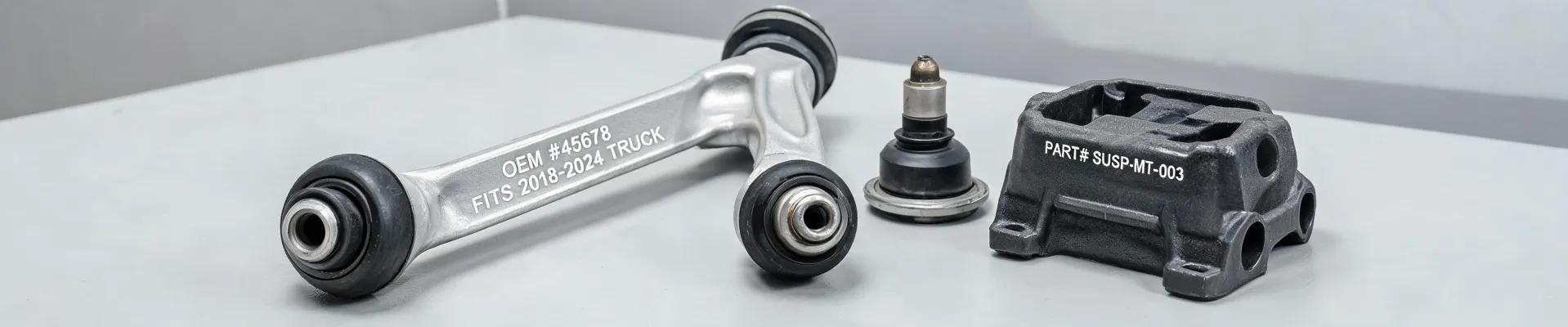
We handle stamping and CNC machining in-house, forging through a long-term partner, and aluminum extrusions with a dedicated mill that's already integrated into our workflow. The point isn't that we own every machine. The point is that the customer doesn't have to run logistics between three different vendors. Last year, a customer had a component family with an extruded aluminum body and a stamped interior support. The original plan had three suppliers and an 18-day assembly lead time. We consolidated the job: the extrusions arrived in two days from our partner, the stamping ran in-house, and the CNC finishing happened immediately after. The entire order shipped on day eight. Not due to magic, but because there were no handoffs between plants.
Prevention Is the Most Efficient Move
Let me also address the question mechanics ask: what causes a blown head gasket? Usually it's a thermal event—overheating, coolant loss, or a blocked cooling system. But after a head gasket failure, the engine teardown creates an immediate need for replacement brackets, shields, spacers, and machined fasteners. That's the part we see. The emergency isn't the failure itself; it's the supply chain that isn't ready to support the repair.
This is where a lot of suppliers get it wrong. They love to advertise "rush service" because they can charge a premium. But a good process can prevent the rush from happening in the first place. When we review a new drawing for manufacturability, we catch problems early—like a bend radius that's too tight for the material grade, or a surface tolerance that would require an extra machining pass. Part of that review is digital now. Our quoting system extracts geometry rules automatically, flagging over-thin walls or poor bend radii before a human even opens the file. Catching that in the design review costs a day. Catching it in the die tryout costs two weeks. And if it's caught on the assembly line, it becomes a rushed redesign that nobody wanted.
We also get the occasional call about a Paccar PX9 DPF delete kit. We turn those down. That's not a moral judgment, it's a process decision—emissions bypass parts create regulatory exposure for everyone involved, and we'd rather lose a rush order than create a compliance nightmare. Sometimes the most efficient process is saying no.
On the quality side, we're careful not to promise "zero defects." That's a red flag, and per FTC advertising guidelines, any claim like that needs substantiation. We don't promise impossible perfection. We promise a controlled process, documented with PPAP and IATF-compliant checks. For a client who needs a stamped bracket inside a differential on an urgent basis, that controlled process is worth more than a guarantee from a maverick who's never been audited.
The Objection and the Boundary
To be fair, in-house tooling and multi-process integration aren't the right answer for every customer. If you need one prototype bracket for a custom hot rod, the smartest move is a local job shop with a CNC mill and a press brake. They'll do it cheaper and faster than a vertically integrated plant with a progressive die team. My experience is based on roughly 200 rush orders in the automotive space, and most of those came from OEM and Tier 1 programs with production repeatability. If you're in a different corner of the market, your calculus is different.
I'm also only speaking to what we've done in our own facility. If your supply chain is international, then customs, freight, and time zones add layers that change the game entirely. The core principle—the more you control, the faster you can respond—still applies, but the practical details don't translate one-for-one.
The Bottom Line
So here's my opinion after six years of emergency orders: stop asking suppliers how fast they can run a machine. Ask them where their dies are made, whether the stamping and CNC happen on the same site, and what their drawing review looks like before they quote. Those are the real speed levers. The supplier that can guarantee a 36-hour turnaround isn't necessarily the one with the fastest equipment—it's the one whose process chain is short enough to do it without chaos.
We can't help with Bilstein coil springs or a Bilstein B6 4600 rear shock absorber—that's the suspension Bilstein. And we won't touch a DPF delete. But if you have a part that needs stamping, forging, CNC machining, or an aluminum extrusion, and the deadline is frighteningly close, the answer is not to look for a hero. It's to look for a process that doesn't need one.
Efficiency isn't a side benefit. It's the competitive weapon that turns emergencies into just another Tuesday.

Elise Novak
Elise Novak is an automotive braking systems analyst specializing in brake pads, discs, rotors, calipers, shoes, drums, hoses, and complete brake kits. She uses UN Regulation 90 requirements and ISO 26867 dynamometer methods to examine friction stability, fade and recovery, wear, disc thickness variation, runout, and hydraulic integrity. Her work helps distributors, quality teams, and fleet buyers compare replacement parts, verify application suitability, and define incoming-inspection criteria.
Leave a sourcing comment