I'm a production coordinator at Bilstein, an automotive metal parts manufacturer. That's the Bilstein that stamps brackets, builds progressive dies, CNC-machines components, forges parts, and extrudes aluminum — not the famous shock absorber company. I'll get to that name mix-up in a moment, because it's actually a useful lesson in brand value.
In nine years, I've coordinated more than 300 rush orders, from a $500 prototype run to a $15,000 emergency die repair. “Rush” looks different from the plant floor than it does from the purchasing office. When you buy parts, a rush order means getting your line back up. When we make them, it means a cracked die steel, a press that has to be cleaned and re-set, a truck that has to leave by 5 PM, and a customer's entire week hanging on a window we can't stretch.
In March 2024, a customer called at 3:40 PM on a Tuesday. His line was scheduled to stop at 6 AM Thursday, and he needed 1,200 stamped mounting brackets installed before the first shift — about 38 hours from the phone call. Normal lead time on that part: three weeks. The reason for the scramble? The vendor he'd bought brackets from at 8% less had been ignoring his emails for ten days. No answers. No parts. No apology. Just silence.
We made the parts. He got them at 9 PM Wednesday, nine hours before that line would have gone dark. And the real lesson isn't “Bilstein saves the day.” It's that the cheap vendor cost that customer more in a single night than he'd saved in a year of orders — a day of scrambling, an overnight freight bill, and a plant that came within nine hours of a complete stop.
The most expensive part you'll ever buy is the one that was cheapest at checkout. I know that sounds like a sales pitch. Honestly, I'd rather it didn't. And if you're shopping strictly on price, our name probably won't make your shortlist anyway. But nine years of watching purchase orders fail has convinced me of that one sentence more than any profit-sharing plan ever could.
The Clogged Fuel Filter Cost Trap
The easiest way to see this is with a part you already know. The clogged fuel filter cost is usually small — $15 to $30 for the filter, plus maybe an hour of labor. A fuel pump that dies because it spent months pulling fuel through that clogged filter? That's $400 to $1,100 installed, based on repair-chain quotes from early 2025. Verify current pricing before budgeting, because labor rates move. Trust me on this one: the filter is a $25 decision. The pump is the $800 consequence.
Nobody plans for the consequence. It's just a filter — how bad can it really be?
Now translate that into industrial sourcing. The “filter” is the die that cracks because the steel was 15% cheaper. The bracket that corrodes because the plating was thin. The weld that didn't penetrate because the fixture was rushed. The “pump” is the $60,000 line stop, the warranty claim, the customer who quietly starts ordering from your competitor. You never see that cost at checkout. You see it on the P&L.
What Is the Throttle Body in a Car? (And Why a Buyer Should Care)
If you landed here after searching “what is the throttle body in a car,” stay with me — this isn't a bait-and-switch. The throttle body is the valve between the air intake and the engine's intake manifold. It meters how much air gets in. When it's dirty or failing, the car idles rough, stalls, or feels gutless. Small part. Critical job. The whole engine depends on it.
That's this entire argument in a single component: the part nobody gets excited about is often the one that decides whether the whole system works.
Front Strut Assemblies and the Price of Precision
Now, about the name. Yes, there is a famous Bilstein that makes shock absorbers — Bilstein shock absorbers and the Bilstein front strut assembly are genuine benchmarks in the aftermarket. That's a different company. No affiliation. I don't mind the mix-ups, though. That company built its reputation over decades of racing wins, and it sets a standard for the name that we'd be idiots to disrespect.
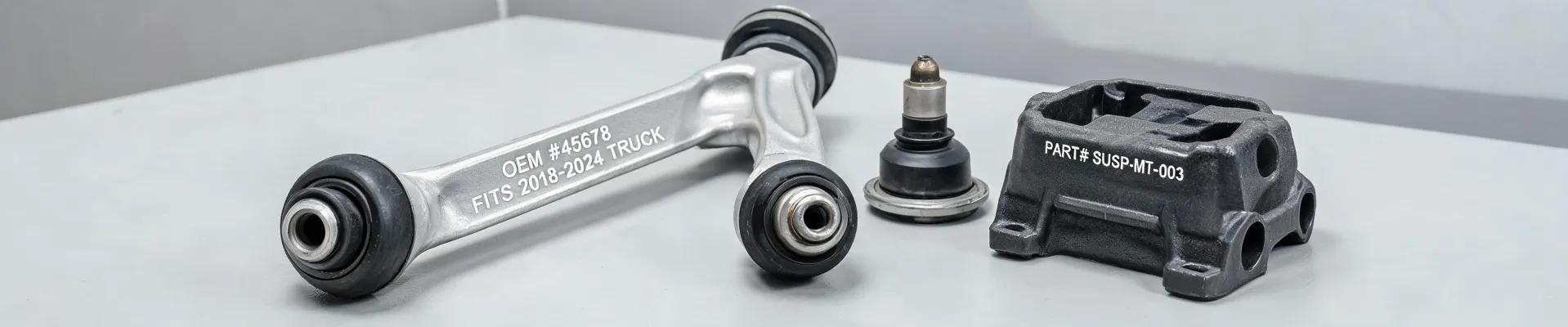
I bring up the Bilstein front strut assembly because a strut is barely a shock at all. It's a structural member of the suspension. The mount, the spring seat, the brake-line brackets — each is a stamped or machined part held to a tolerance. Our progressive dies hold ±0.1 mm at high speed. Slip half a millimeter and you won't see it at the assembly bench. You'll feel it at 25,000 miles: uneven tire wear, a pull in the steering wheel, a customer convinced the whole batch is junk.
Same logic applies to forgings and aluminum extrusions. If the heat treatment is off, the metallurgy is a quiet lie. If the machining is off, the part can't be assembled without “persuasion.” The supplier who charges a little more because he refuses to ship a lying part isn't adding cost. He's adding insurance.
And here's a detail that never appears on a purchase order: color. When a coated bracket has to match a brand-critical color, the industry standard is Delta E < 2 per Pantone's color matching guidelines. It's an invisible number. It's also the difference between a part that disappears into the assembly and one that screams “cheap” from twenty feet away.
A $50 Muffler and the $4 Hanger
The Thrush Hush muffler is a genuinely good aftermarket part — deep tone, no drone, decades of loyal buyers. People seek it out by name. Then they hang it on exhaust hangers and brackets that never cross their minds again.
We stamp exhaust hangers by the hundreds of thousands. They look like nothing: a strip of steel, a couple of holes, a bend or two. But if the hanger is too thin, or the geometry is off, the muffler transmits vibration into the body, or a weld cracks after a year of bumps. Now you have a $50 muffler that rattles, and the owner says it sounds like a can of bees. The muffler takes the blame. The forgotten hanger did it.
Nobody asks about the hanger's price. But it's the part of the purchase that decides whether the whole exhaust system feels premium or cheap. Value isn't in the part you named. It's in the parts you never name.
You Learn Everything About a Supplier at 11 PM
Here's where I have an unfair advantage: I've been the emergency guy for nine years. We track rush orders because our customers' lines stop, and a stopped line at a mid-size automotive plant burns $8,000 to $15,000 an hour. If I deliver an hour late, I've just erased whatever discount the buyer negotiated six months ago.
Last year we processed 47 rush orders and hit 95% on-time delivery. 94.7%, if I'm being precise — which I am, because I look at the scoreboard. When I'm triaging a rush order, the questions are simple: how much time do we have, can we actually hit it, and what's the worst case if we can't? A supplier who asks those questions out loud, and answers honestly even when the answer is “not comfortably,” is worth more than one who says “no problem” and goes silent.
I still kick myself over a decision I made in 2022. Two plating vendors: one established, one 12% cheaper. I went back and forth for two weeks. On paper, the cheap one checked out. My gut said no. I signed anyway. Six months later — six months and two weeks, actually — the finish started failing salt-spray tests, and Ohio winters finished the job. Brackets rusting in the field. We spent $8,400 on rework and re-plating, plus client goodwill I still haven't fully won back. The 12% I saved? About $900. There is no math where that works.
I've felt the other side too. We once had a delivery that absolutely had to land by Friday. Premium overnight freight cost $800. I hit approve and immediately thought: did I just give money away? I didn't relax until the truck pulled in Thursday. The customer's alternative was a $12,000 line shutdown. But nobody could have proven the expensive shipping was necessary. That's the point. Value rarely announces itself in advance.
“But My KPI Is Price”
The objection I hear most from buyers: “our KPI is the invoice price.” Fine. I've sat in those meetings. But a scorecard that only measures the sticker price is how you end up paying the fuel pump bill. Add the measurable stuff — non-conformance rate, defects per million, on-time delivery in full, response time when something goes sideways. And add the stuff you can't measure but can't ignore: whether the supplier answers at 11 PM, whether he tells you bad news early, whether the part that arrives is the part he promised.
We're not saying “never compare prices.” That would be absurd, and our quotes lose on price all the time. Compare all you want — but compare total cost, not sticker price. A part that fails at 3 per thousand and a part that fails at 0.2 per thousand are not the same part, no matter what the drawings claim.
Buy the Value, Not the Cheap Quote
So I'll end where I started. The cheapest part is rarely the cheapest part. The invoice is just the entry fee. The real price includes the line stops, the rework, the emergency freight, the lost trust, the warranty fights. It's the clogged fuel filter of purchasing — a small savings that looks harmless until the fuel pump complains.
If you need a stamped bracket, a CNC-machined component, a progressive die, a forging, or an aluminum extrusion done right, we'd welcome the conversation. If you need the lowest possible quote, we're probably not your supplier. That's fine. I'd rather lose the job than watch you learn this lesson the expensive way.
Numbers in this post — part prices, downtime estimates, delivery stats — were accurate as of early 2025. This market changes fast, so verify current pricing and lead times before you build a budget around them. And if you came here asking “what is the throttle body in a car,” now you know: it's the small valve that controls everything downstream. Kind of like this whole argument.

Elise Novak
Elise Novak is an automotive braking systems analyst specializing in brake pads, discs, rotors, calipers, shoes, drums, hoses, and complete brake kits. She uses UN Regulation 90 requirements and ISO 26867 dynamometer methods to examine friction stability, fade and recovery, wear, disc thickness variation, runout, and hydraulic integrity. Her work helps distributors, quality teams, and fleet buyers compare replacement parts, verify application suitability, and define incoming-inspection criteria.
Leave a sourcing comment