The Bilstein Catalogue Is Not What I Expected
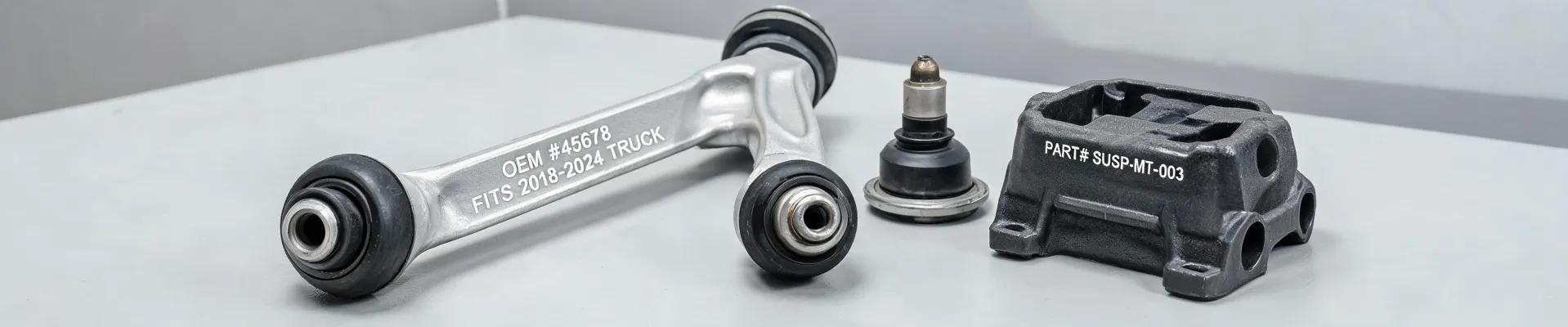
When I took over purchasing in 2020, my service manager handed me a supplier login and said, 'Learn the Bilstein catalogue.' I assumed he meant shock absorbers. He didn't. In our shop's world, the Bilstein catalogue is the parts system for stamped, forged, and CNC-machined metal components: suspension links, coil pack brackets, aluminum extrusions, sway bar links, and the small brackets that seem impossible to find anywhere else. This distinction matters more than you'd think. A customer asks about suspension Bilstein, and by default everyone pictures the shock-absorber brand. If I'm not careful, I order a damper when the actual job is a stamped stabilizer link. The catalogue forces me to check the part number, the vehicle platform, and the press code before I commit. Put another way: it stops me from making a $150 mistake because I guessed from a name. Our supplier builds the progressive dies and molds in-house, which is why the catalogue includes parts that parts stores don't stock. I've been doing this long enough to know that part-number discipline is what separates a smooth Monday from a we're-waiting-on-parts day. We process around 60-80 orders a month. Maybe 65, I'd have to check the system. The ones that break down are almost never the expensive parts; they're the ones where someone was sure they knew the right number.How to Tell If a Sway Bar Link Is Bad (Non-Mechanic Edition)
I can't give you a torque spec. I can't tell you if your sway bar has separated bushings or end-link ball joints. That gets into mechanic territory, which isn't my expertise. What I can tell you from a purchasing perspective is what triggers a sway bar link replacement order:- A metallic clunk from the front or rear when the car crosses a speed bump. Clunk, clunk, clunk.
- A click or knock when turning slowly into a parking spot.
- A cracked or grease-covered boot on the link, if you can get under the car long enough to look.
- Visible play in the link. I leave that test to the mechanics, honestly.
The $38 Ignition Coil Pack That Cost Me $450
In January 2024, we needed an ignition coil pack for a delivery van. The shop estimate used an OEM part at $180. I found a listing that said 'compatible with OEM' for $38. The upside was saving over $140. The risk was a repeat repair and an angry customer. The mechanic warned me. I ordered the cheap one anyway. It lasted three weeks. The van came back on a tow truck. Total cost: $140 towing, $180 for the OEM coil pack, and half a morning of labor. The $38 part turned out to be the most expensive ignition coil pack I've ever approved. I still kick myself for not asking for data behind the 'compatible' claim. Per FTC guidelines (ftc.gov), a supplier that says 'OEM compatible' has to be able to substantiate it. I didn't ask. Now I do. What I mean is the total cost of a part includes your time spent managing returns, the chance of a repeat repair, lost bay time, and the customer relationship. Not just the line item on the invoice.Oil Filter Cost: The Smallest Line Item, the Biggest Argument
Oil filter cost is the one line item customers argue about most. Based on quotes from our local suppliers in January 2025, a standard spin-on filter runs anywhere from $4 to $18. For a repair shop, that difference is less than 2% of a typical oil change invoice. But a filter with the wrong bypass valve can starve an engine or dump dirty oil after a cold start. I'm not an engineer, so I don't argue about filter media specs. I just stick with the oil filter spec recommended by the vehicle manufacturer. Put another way: the oil filter cost is not the risk. The risk is the cost of the engine damage that might follow a bad $4 filter. Our shop stopped using no-name filters in 2022, and I've never had a finance person complain about the $10 difference.Why I Pay for Delivery Certainty
After the coil pack incident, I changed our purchasing rule of thumb. If a part is needed for a car that's promised to a customer, I choose the vendor who can guarantee a delivery window, even if the part costs $10 to $20 more. If the car is sitting in the back lot with no deadline, I'll use the slower, cheaper vendor. That's the boundary. In May 2024, a customer needed their car back for a road trip. The replacement sway bar link was on national backorder at one warehouse. Our regular supplier had it in stock and could deliver by 10 a.m. They charged $14 for expedited shipping. I paid it without asking twice. The car left on time. There's something satisfying about a rush order that shows up exactly when it's supposed to. Look, I'm not saying premium shipping is always justified. A 2012 sedan that only moves on weekends can wait three days for a $12 sway bar link. But a customer who already paid for a repair and is standing at the counter? 'Probably on time' is the riskiest phrase in our industry. The price of a missed deadline is not the shipping fee; it's the phone call to explain there's no car. Bottom line: the best part is the one that arrives when it's supposed to.The Edge Cases
My experience is based on one 14-person shop in the mid-Atlantic, roughly 650 repair orders a year. We work with domestic and Asian vehicles, not heavy trucks or exotics. If you're a mobile mechanic buying for your own van, your calculus might be different. Also, a clarification: the Bilstein catalogue I use is a metal-components catalogue, not the shock-absorber brand. If you're searching for 'suspension Bilstein' dampers, don't take my example as a reason to skip checking what your actual part number is. And if you're a shop owner reading this, ask your parts admin how often they check reference numbers before ordering. The answer might be the difference between a great week and a string of expensive comebacks.
Elise Novak
Elise Novak is an automotive braking systems analyst specializing in brake pads, discs, rotors, calipers, shoes, drums, hoses, and complete brake kits. She uses UN Regulation 90 requirements and ISO 26867 dynamometer methods to examine friction stability, fade and recovery, wear, disc thickness variation, runout, and hydraulic integrity. Her work helps distributors, quality teams, and fleet buyers compare replacement parts, verify application suitability, and define incoming-inspection criteria.
Leave a sourcing comment