Two Sourcing Paths, One Real Decision
I'm a cost controller by nature, and for the past seven years I've managed procurement for a mid-sized automotive components company. That means I've tracked roughly $1.7 million in annual external spend, evaluated 30+ metal parts suppliers, and built more comparison spreadsheets than I care to admit. The question I keep coming back to is simple: should you keep sending each operation to a specialist, or hand the whole metal parts package to a multi-process supplier?
For this article, I'm comparing two approaches:
- Option A: Single-process specialists. A stamper for brackets, a CNC shop for housings, a forger for lugs, an extruder for rails. Each one is good at its own process.
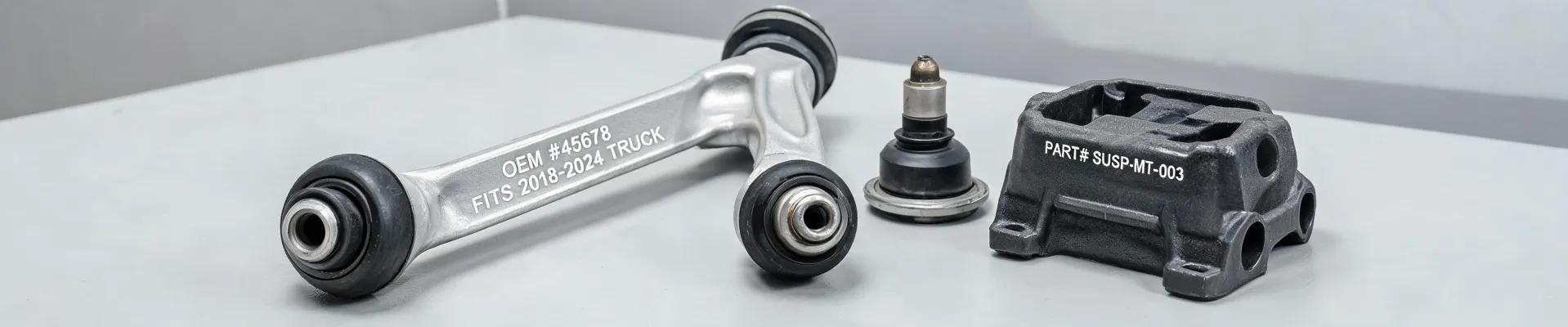
- Option B: Multi-process manufacturing. A supplier like bilstein that handles stamping, tooling, CNC machining, forging, and aluminum extrusions in-house.
I'm not going to tell you one is always better. I will show you the dimensions I actually compare on: tooling and upfront costs, coordination load, quality risk, and the assumptions hidden by product names.
Dimension 1: Tooling and the 'Cheap Quote' Trap
It's tempting to think a dedicated stamper will give you the best stamping price. That's often true for unit price. But the first time I compared total cost, I found something weird: the 'cheaper' specialist charged separately for tooling revisions, sample runs, and material certificates. The multi-process supplier's quote listed everything upfront. Per FTC guidance (ftc.gov), advertising claims should be truthful and not misleading. I wish the same rule applied to every B2B quote.
In 2024, I was sourcing a bracket for a ram 2500 bilstein steering stabilizer. The bracket isn't an exotic part. It needs a progressive die stamping, a few formed flanges, and a corrosion coating. I got quotes from a single-process stamper and from bilstein. On paper, the stamper's unit price was 11% lower. But after I added their $1,800 tooling modification fee, $450 material cert charge, and $300 paperwork handling fee, the total landed cost was 4% higher than bilstein's all-in quote.
I don't have hard data on how often this happens across the industry. But based on 40+ vendor quotes I've analyzed, my sense is that 'low baseline price, high add-on' is more common than buyers want to admit.
Dimension 2: Coordination Costs Are Real Costs
This is where the comparison stops being about numbers on a purchase order. When you split a parts package across four vendors, someone has to manage the handoffs. A stamping vendor sends pieces to a heat treater, then to a CNC shop, then to coating. You're the one chasing delivery dates and answering fit-up questions.
The same piece coming from a multi-process supplier means one project manager owns the tolerances. I've had orders where simple spark plug connectors—a terminal plus its machined aluminum housing—were made by two different vendors. The terminal supplier made it to print; the housing supplier made it to print. But the assembled crimp height didn't meet spec, because neither vendor had tested the two parts together. That's not a quality failure you can put on one supplier.
A multi-process supplier catches these issues before they become arguments. That might sound obvious, but I've seen it save an entire production week.
Dimension 3: Risk and 'Who Do I Call?'
Let's talk about the late-night phone call. When the line is down because a machined bracket doesn't fit a forged lug, who do you call? With single-process specialists, you start with the stamper. He says the material was too hard. You call the CNC shop. They say the drawing was ambiguous. The coating vendor says they followed instructions. Meanwhile, your plant manager is checking his watch.
With a multi-process supplier, there is one accountable party. That matters more when a part appears in a bilstein b12 suspension kit—where the spacer, spring seat, and strut mount have to fit together after being formed and machined separately.
To be fair, single-process specialists are not always the problem. If you have a mature part with a fixed design, a specialist can be excellent. But if the design is evolving, or if there's any chance of a tolerance stack between parts, you need someone who can look at the whole assembly.
Dimension 4: What Searches Tell Us About Assumptions
Search behavior creates a false picture. Someone googles 'honeywell heat pump thermostat' and assumes it's one product. But the thermostat bracket inside that product might be an aluminum extrusion, cut to length, milled, and tapped. Another person searches 'how to tell if your oil pump is bad' because they have noise or low pressure. As a buyer, I see 'bad oil pump' as a casting-quality problem: a porous housing or a badly machined mating surface fails long before the pump gets installed.
The same logic applies to 'spark plug connectors.' From the outside, they look like commodity stampings. The reality is that a quality connector terminal can require a specific plating process, a controlled spring temper, and a crimp test that the print doesn't fully describe. The best time to catch those details is during tooling design, not after receipt.
I'm not telling you to ignore search volume. I'm telling you to separate the product name from the manufacturing challenge. The product name might be 'ram 2500 bilstein steering stabilizer.' The manufacturing challenge is a stamped bracket, a machined mount, and a fastener that all have to align. That's a multi-process problem.
The Surprising Conclusion
Here's the part that went against my initial assumption. Actually, let me be more precise: it went against my gut. My gut said the specialist would be faster on samples. The data said the opposite. In two separate cases, bilstein delivered samples faster than the specialist vendors who had to wait for outside tooling and subcontracted finishing. I do not have a controlled study to prove this is a universal rule—only my own order history. But the pattern was clear enough that I now include 'tooling lead time' as a decision line in every supplier comparison.
That said, I've also seen the reverse. When a job was mostly one operation—for example, a simple high-volume stamping with no secondary machining—the specialist was the better choice. The multi-process supplier's quoting process was more complex, and I paid extra overhead for capabilities I didn't need. So the honest answer is: it depends on the mix of processes in your part package.
When to Choose Option A vs. Option B
After tracking 8,000+ order lines, here's my decision rule:
- Choose single-process specialists when: the design is frozen, the part requires one core process, and you have engineering bandwidth to manage tolerances and vendors.
- Choose a multi-process supplier when: your part family mixes stamping, CNC, forging, or extrusion; when tooling is still being debugged; or when you want a single invoicing, shipping, and accountability point.
I've learned to ask 'what's NOT included?' before asking 'what's the price?' The vendor that lists all fees upfront—even when the total looks higher—usually costs less in the end.
If you're evaluating metal parts suppliers, build a total-cost sheet that includes tooling, coordination hours, incoming inspection, freight to your dock, and the cost of a late delivery. Then compare. The better option will usually reveal itself—and it isn't always the one with the lowest line-item price.
Note: The bilstein industrial parts manufacturer discussed in this article is a separate company from Bilstein GmbH, which sells the suspension products named above.

Elise Novak
Elise Novak is an automotive braking systems analyst specializing in brake pads, discs, rotors, calipers, shoes, drums, hoses, and complete brake kits. She uses UN Regulation 90 requirements and ISO 26867 dynamometer methods to examine friction stability, fade and recovery, wear, disc thickness variation, runout, and hydraulic integrity. Her work helps distributors, quality teams, and fleet buyers compare replacement parts, verify application suitability, and define incoming-inspection criteria.
Leave a sourcing comment