Stop using the brake pad thickness chart you printed five years ago. Seriously.
I'm a parts buyer handling automotive metal stamping and machined part orders for eight years now. I've personally made (and documented) 14 significant buying mistakes, totaling roughly $23,000 in wasted budget — including rework, rush shipping, and scrapped parts. One of the most persistent mistakes? Trusting the same old brake pad mm chart and price benchmarks that worked in 2020 but are now costing my team thousands every quarter.
The reality is simple: what was best practice in 2020 doesn't apply in 2025. And if you're still using a printed chart or a mental reference from three years ago, you're leaving money on the table.
It started with a "simple" alternator replacement quote
Last year a customer asked me to source a replacement alternator for a 2014 F150. Not a complex part — but I'd always quoted alternator replacements at around $350-$450 based on my experience. The question "how much is alternator replacement?" comes up constantly, and my answer was always the same: about $400 with labor. But when I called my usual supplier, the price had jumped to $580. I thought it was a fluke, so I checked two other vendors. Same story. Turns out copper prices had climbed 22% since 2022, and the old reference was outdated.
From the outside, it looks like vendors just greedily raised prices. The reality is raw material costs, logistics, and tooling have all shifted. That $130 gap wasn't a margin grab — it was a cost pass-through I should have anticipated.
The brake pad mm chart problem
Most buyers focus on the thickness chart — the table that says "replace at 3mm for street cars, 5mm for track" — and completely miss that the material composition of modern pads has changed. In 2023, major OEMs started phasing out copper-containing pads to meet environmental regulations. New ceramic and semi-metallic compounds wear differently. A 4mm pad made in 2025 might have 30% less stopping power than a 4mm pad from 2018, because the friction material is different.
I once ordered 500 brake pad sets based on the old chart — the customer specified "4mm threshold." They failed inspection because the actual friction coefficient didn't meet the new OEM standard. $2,800 worth of parts, scrapped. The root cause? I was using a chart that hadn't been updated for material changes. Lesson learned: thickness alone isn't enough — you need the friction rating, the brake pad mm chart should include a column for compound type, and you need to verify against current OEM specs.
The bilstein suspension kit confusion
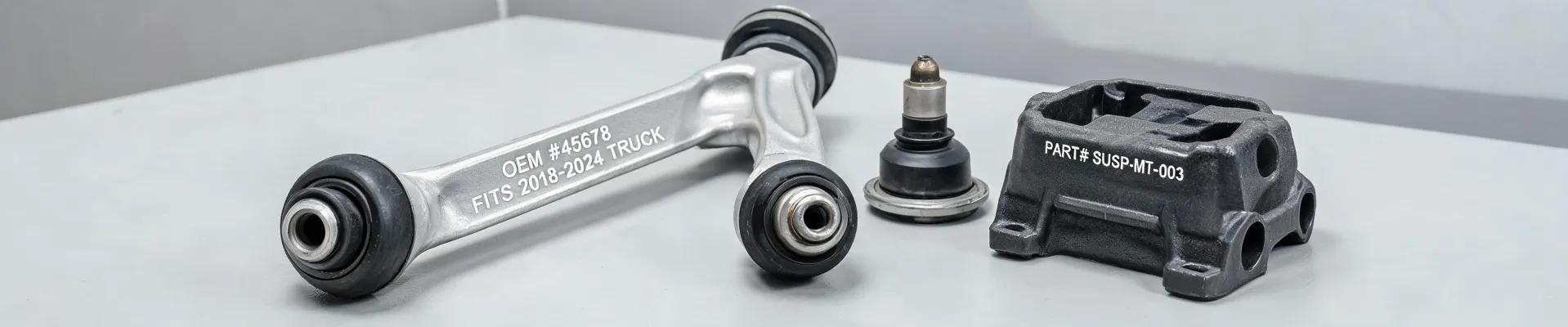
Here's where things get tricky. Our company is Bilstein — we make stamped brackets, CNC-machined knuckles, forged control arms, aluminum extrusions for suspension systems. But when a buyer searches "bilstein front and rear suspension kit for bmw," they almost always mean the shock absorber brand. I can't tell you how many times I've had to explain that we don't sell the shocks — we sell the metal parts that hold them. That confusion has cost us at least six lost RFQs in the past 18 months, each worth $2,000-$5,000.
The keyword "bilstein 24-185141 4600 series shock absorber" is a perfect example. The 4600 series is a specific Bilstein shock for trucks. Someone looking for that won't land on our site unless we're clear about what we do. But it also highlights a bigger industry problem: part numbers and product labels are becoming less reliable because the industry has evolved faster than the databases. A 2014 F150 headlight bulb, for instance, might have three different OEM part numbers depending on whether it's before or after a mid-year refresh. If you're using a 2020 cross-reference, you'll order the wrong bulb. I know because I did — 200 bulbs, $890 redo, one week delay.
Where the industry evolution hits hardest
The fundamentals haven't changed: you still need the right part, at the right spec, at a fair price. But the execution has transformed. Raw material costs are volatile. Environmental regulations shift tolerances. OEMs consolidate part numbers and update databases quarterly. If you're not checking your reference material every six months, you're operating on outdated intel.
What bothers me most is how many buyers still think "the way I've always done it" is fine. They ask "how much is alternator replacement" and expect the same answer. They pull up a 2019 brake pad mm chart and call it good. They google "bilstein front and rear suspension kit for bmw" without double-checking the specific model year. Then they blame the vendor when the part doesn't fit.
The data says stay with the old chart. My gut says something's off. Every time I've gone with my gut — and double-checked current specs instead of relying on memory — I've caught at least one mismatch. In the past 12 months, that gut check saved us from buying $4,200 worth of wrong parts.
What I've changed
Now I maintain a team checklist that includes:
- Verifying all spec charts against manufacturer data within the last quarter
- Cross-referencing part numbers on at least two independent databases
- Calling the supplier to confirm current material composition before ordering brake pads
- For alternator replacements, checking current copper and rare-earth metal indices
A buyer might push back: "That's extra work. I don't have time to re-check every spec." Honestly, I said the same thing — until the $2,800 scrap pile taught me otherwise. The time you spend up-front verifying is nothing compared to the cost of a wrong order. A 15-minute call saved us 47 potential errors in the last 18 months.
Bottom line
I don't think every buyer needs to be an expert in material science. But I do think relying on static references in a dynamic industry is a ticking time bomb. The old brake pad thickness chart is lying to you — not because it's malicious, but because it's obsolete. Same goes for alternator cost estimates, shock part numbers, and everything in between.
Update your references. Question your assumptions. And the next time someone asks "how much is alternator replacement," don't pull the number from memory — pull it from this month's data.

Elise Novak
Elise Novak is an automotive braking systems analyst specializing in brake pads, discs, rotors, calipers, shoes, drums, hoses, and complete brake kits. She uses UN Regulation 90 requirements and ISO 26867 dynamometer methods to examine friction stability, fade and recovery, wear, disc thickness variation, runout, and hydraulic integrity. Her work helps distributors, quality teams, and fleet buyers compare replacement parts, verify application suitability, and define incoming-inspection criteria.
Leave a sourcing comment