First, the Bottom Line
If you take one thing away from this article, let it be this: the brand stamped on a part tells you less than the specification behind it. In my job, I review around 200 unique automotive part numbers a year, and I've rejected roughly 7% of first articles in 2025 so far—mostly for dimension drift, mismatched material certifications, or suppliers who "forgot" to include the test data they promised.
That principle applies just as much when you're ordering bilstein 5100 struts for your truck as it does when you grab a 2006 CRV headlight bulb off the shelf. Specs, measurements, and traceability beat labels every time. I've been burned enough to know. Trust me on this one.
Who I Am, and How a $22,000 Mistake Changed My Approach
I'm a quality compliance manager at Bilstein—the automotive metal parts company, not the German suspension brand. We manufacture stampings, progressive dies, CNC-machined components, forgings, and aluminum extrusions for Tier 1 suppliers. If it's a structural metal part on a vehicle, there's a decent chance our tooling or our machines had something to do with its lifecycle.
That puts me in a specific spot. I approve or reject production parts before they ship to customers, and I audit suppliers to make sure their real-world output matches the documentation they submitted. Over four years, that's a lot of samples. In our Q1 2024 quality audit, we reviewed 152 first-article submissions and flagged 11. That's not because the industry is full of bad actors—it's because precision manufacturing is hard, and paperwork is harder.
In my first year, I made the classic rookie mistake: I assumed "standard tolerance" meant the same thing to every vendor. It doesn't. One supplier read our drawing and interpreted a critical hole at ±0.1 mm; another read the same callout and used ±0.5 mm. That discrepancy cost us a $22,000 redo and a delayed product launch. Now, every contract, PO, and drawing includes that tolerance in plain language. Three places, because people skim.
Looking back, I should have caught the ambiguity before production. At the time, I trusted the supplier's engineering team to flag it. They didn't. The lesson stuck: define expectations in writing, then verify against them. It's the same reason I go back and forth on supplier decisions—last year I spent two weeks weighing an 8%-cheaper vendor who couldn't hold our required Cpk of 1.33 on a critical dimension. On paper, they were acceptable. My gut said no, so I went with the established shop. A few months later, the cheaper vendor failed another customer's audit. Data matters; instincts matter too.
The Two Bilsteins, and What to Check on Suspension Parts
Let's clear up the name confusion, because it pops up in my inbox weekly. Searching bilstein surfaces two different companies. There's us—Bilstein, the metal parts manufacturer. And there's Bilstein GmbH, the German suspension brand best known for the bilstein 5100 struts and the bilstein b3 oe replacement coil spring line. We can't quote a strut, and they likely won't design a progressive die for you. Nothing against them—different products, different customers. Just know which bilstein you're contacting before sending an RFQ.
If you are shopping for suspension hardware, here's the inspector's checklist I'd apply:
- Coil springs: measure wire diameter, free height, and spring rate at the vehicle's installed height. Most people measure length and stop—but rate is what actually controls ride height and comfort.
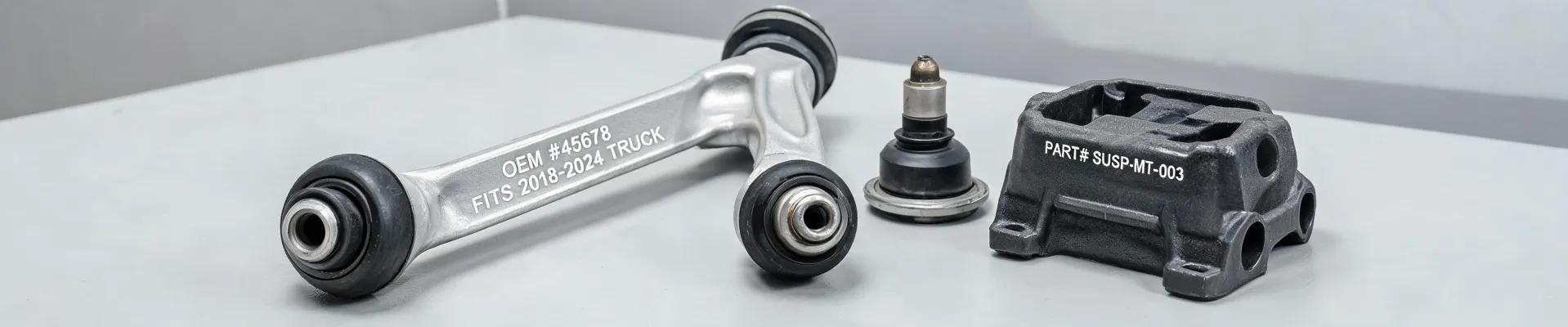
- Struts: verify mounting dimensions, upper stud pattern, and body diameter. Then look at the weld quality on the lower bracket. A rough weld is a stress riser; stress risers become cracks.
- Traceability: does the package include a material test report or a heat number? If a manufacturer can't tell you where the steel came from, that's a red flag.
The 5100 series is popular for leveling trucks because of the adjustable spring seats. Nice feature, but the adjuster threads are a common failure point on knockoffs—burrs on the threads feel fine in the box, then seize after a winter of salt exposure. Run a finger over the threads before you install (seriously, this takes ten seconds).
On the bilstein b3 oe replacement coil spring, the "OE replacement" label is reassuring but not a legal definition. It's a marketing term. In my experience, the b3 coils are decent—dimensions and rate are typically on point. But verifying costs nothing: measure the wire diameter and compare it to the OEM spring you're replacing. If they match within a millimeter and a few percent of rate, you're probably good.
What was best practice in 2020 no longer cuts it in 2025. Back then, a spec sheet and a prayer were accepted. Now the better brands publish damping curves, attach material certs, and maintain batch traceability (as of early 2025, at least). The evolution is real—buyers should expect it.
Three Car Questions I Keep Getting, Answered Honestly
Because our name starts with "bilstein," people assume I'm a suspension guru. I'm a metal parts guy, but I've picked up a few things from reading failure analyses and talking to engineers.
Radiator Steam Vent
A radiator steam vent—that white hissing cloud under your hood—is not a normal thing. It means coolant is boiling or escaping as vapor. More often than not, the culprit is a stuck radiator cap, not a blown head gasket. The cooling system is designed to hold pressure; when the cap wears out, the boiling point drops and you get steam in places it doesn't belong.
If it were my car, here's the plan: pressure-test the system, inspect the cap, and look for dried coolant residue around the tank seams. Don't throw a radiator at it on a hunch. A $20 cap can save a $2,000 engine—same "verify before you replace" discipline we use in the plant.
2006 CRV Headlight Bulb
The 2006 CRV headlight bulb is a classic DIY job. Low beam is H11; high beam is 9005 on most trims. The part itself is cheap—the two things that kill it are a brittle connector and fingerprint oil on the glass. Touching the bulb glass leaves skin oil that creates a hot spot, and the bulb dies months early. Same principle as clean handling on aluminum extrusions: contamination is a defect, even if you can't see it.
What Is a Rear Differential?
If you've ever typed what is a rear differential into a search bar, here's the short version: it's the gearbox at the center of your rear axle that splits torque between the left and right wheels, letting them spin at different speeds when you turn. Without it, your inside tire scrubs and chirps through every corner.
Inside, a ring-and-pinion set transfers power at a right angle, and the pinion bearings are preloaded to very tight tolerances. On our CNC and gear line, we machine similar components to micron-level spec. When a differential whines, it's usually because backlash was set wrong at installation or the preload drifted. It's not magic—it's measurement.
Where This Mindset Doesn't Apply
Let me balance the ledger. If you're a weekend DIYer swapping a headlight bulb or a radiator cap, you don't need a PPAP or a CMM report. If the part is purely cosmetic, "looks right" is a valid acceptance criterion. And for a low-volume prototype, demanding IATF 16949 from a small machine shop is overkill. Ask for a certificate of conformance and a dimensional report instead—that's table stakes, not bureaucracy.
But for anything that affects steering, suspension, braking, cooling, or drivetrain, the cost equation changes. Total cost per mile beats the lowest invoice price. An unbranded strut that fails in 10,000 miles isn't a bargain; it's a red flag wearing a discount.
To be fair, the industry is moving in the right direction. Suppliers who treated first-article inspection as a checkbox in 2020 are now sending CMM data with every batch because customers expect it. The fundamentals don't change—measure, document, verify. The tools and expectations around them evolve. Bottom line: if you know what you're asking for and why, you're ahead of most of the market.

Elise Novak
Elise Novak is an automotive braking systems analyst specializing in brake pads, discs, rotors, calipers, shoes, drums, hoses, and complete brake kits. She uses UN Regulation 90 requirements and ISO 26867 dynamometer methods to examine friction stability, fade and recovery, wear, disc thickness variation, runout, and hydraulic integrity. Her work helps distributors, quality teams, and fleet buyers compare replacement parts, verify application suitability, and define incoming-inspection criteria.
Leave a sourcing comment