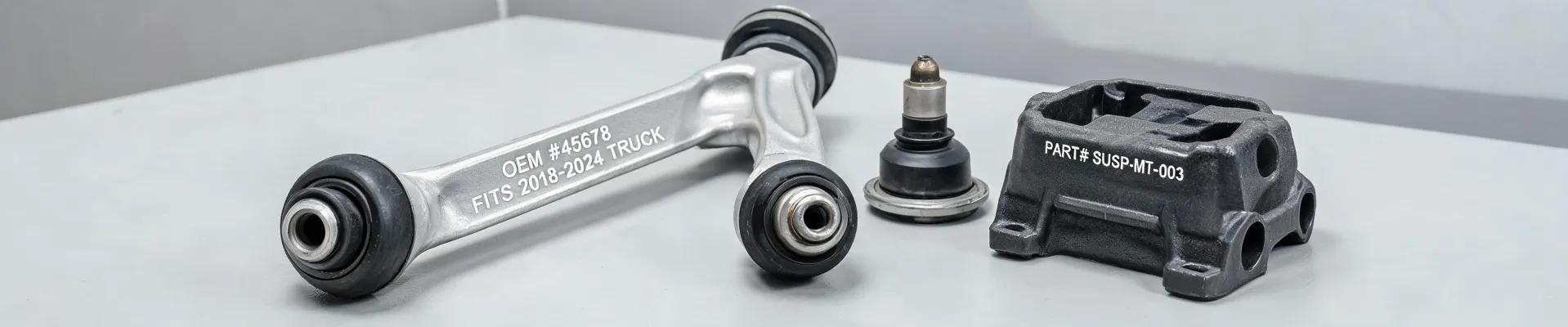
I work for an automotive metal parts company called bilstein—lowercase, that's how the logo has always been. We build stamped metal parts, progressive dies, CNC machined components, forging blanks, and aluminum extrusions. We do not build shock absorbers. We build the brackets and mounting plates that hold shock absorbers to the vehicle. That distinction confuses a lot of people, and one of those confusion moments turned into my most expensive lesson as a quality inspector.
Last spring, a buyer called about a “bilstein front strut ford transit part number”. He was polite, a little rushed, and clearly annoyed that I couldn't tell him from memory whether our stock would fit his van. We don't have a “stock” of struts, for one thing. He'd landed on our site because he was searching for Bilstein B6 shock absorbers for a Ford Transit. The B6 is a real product—from the German suspension company, not from us (and honestly, the mix-up is easy to make). I told him to send us a drawing of the bracket that holds the strut, and we might be able to help. He said he would. He didn't (not that I blame him).
The driveshaft center bearing that wasn't
A few months later, an engineering manager sent us a part number for something he called a driveshaft center bearing. He'd found us online, so he wasn't necessarily an existing customer. Our quoting team looked at the part number, looked at our capabilities, and said “we can machine that housing, let's quote it.” I don't think anyone said “bearing” out loud.
Three weeks into the job, the drawing review landed on my desk. The part number covered a complete center bearing assembly—the steel housing, the rubber isolator, the bearing itself. The drawing we had only covered the steel housing. I knew the customer needed the whole assembly, but the sales rep had already quoted a housing. Somewhere between the search term “driveshaft center bearing” and the actual metal part, the scope had gotten lost.
I knew I should have asked for a sample before we cut tooling. I didn't. I figured, what are the odds? Well, the odds caught up with me.
“Where's the bearing?” the customer's engineer asked when he opened the first-article box.
“We quoted the housing,” I said.
“The part number I sent includes the bearing,” he said.
He was right. The part number was the part number. I had not verified the reference. We made 8,000 housings that looked perfect and didn't do what the customer needed. The rework cost about $22,000 in labor, bearings, and expedited freight. The customer didn't cancel the order, but they also didn't forget. Neither did I.
After that, I changed how we review every inquiry. We still use the AIAG PPAP format for first article reports, and we apply ASME Y14.5 when interpreting GD&T callouts. But the biggest change was simpler: before we quote anything, we ask what the part does in the vehicle. Is it a complete assembly? Is it just the metal component? Who else is in the supply chain?
What I actually check
I've spent about four years and maybe 600 first-article reviews learning that a part number is not a product description. The engineering drawing is the specification. The part number tells you which file to open; the drawing tells you the material, the tolerance, the datum structure, and the coating. If you skip the drawing, you're guessing.
In my role, I review roughly 200 unique part numbers a year. In 2024, I rejected around 6% of first deliveries. Most rejections are quiet: coating thickness a few microns under spec, a hole pattern off by 0.05 mm, a stamping that passes the bench check but fails in the assembly fixture. I once delayed a 50,000-unit annual order because the zinc coating was 4 microns below what the salt-spray test required. The parts looked fine. The test said no.
That's why every kickoff meeting now includes a dimensional layout against the latest drawing revision, material certifications, coating thickness readings, a functional fit check in the customer's fixture, and a first article report. It's not a dramatic list. It sounds kinda boring, but it works. And it would have caught the driveshaft center bearing problem before we cut any steel.
Monroe Quick-Strut, resonator delete, and the real lesson
The same confusion shows up in search terms. A visitor might type Monroe Quick-Strut replacement strut because they want a complete loaded strut with the spring, bearing, and mounting hardware. We don't sell that. But if the visitor represents a company that needs the stamped mounting plate inside that strut, we can absolutely help.
Another search term that lands on our site is “how much does a resonator delete cost”. I'm not going to answer that, because it's not our product. Those searchers want an exhaust shop, not an aluminum extrusion. It was a weird inquiry the first time I saw it, but it taught me something: search intent is a quality variable. If you answer the wrong question, you waste everyone's time. If you answer the right question—"can you make the metal component around the resonator?"—then the conversation makes sense.
So now I spend the first few minutes of every inquiry asking basic questions. What does the part do? Is it the whole assembly or just the metal piece? Which revision of the drawing are we working from? I'd rather spend ten minutes explaining these details than deal with mismatched expectations later. An informed customer asks better questions and makes faster decisions.
Quality means matching the customer's expectation, not just the print
I used to think quality meant “the part matches the drawing.” Now I think it means “the part does what the customer expects.” Those are different standards. The drawing is still the law—I do not mean to diminish it. But a perfect drawing of the wrong scope is still a failure.
It took me an 8,000-piece mistake to understand that. If someone asks for a bilstein front strut ford transit part number, take a minute to find out whether they need the whole shock, a bracket, or a correct reference from a different company. That minute costs nothing. A $22,000 rework costs a lot.
We don't get every inquiry right, and I'm not pretending we do. But after 2022, I implemented a verification protocol that requires a written scope statement before we cut tooling. It feels like extra paperwork. Then I remember the silence in the room when the bearing wasn't in the box. That silence is why I keep asking.

Elise Novak
Elise Novak is an automotive braking systems analyst specializing in brake pads, discs, rotors, calipers, shoes, drums, hoses, and complete brake kits. She uses UN Regulation 90 requirements and ISO 26867 dynamometer methods to examine friction stability, fade and recovery, wear, disc thickness variation, runout, and hydraulic integrity. Her work helps distributors, quality teams, and fleet buyers compare replacement parts, verify application suitability, and define incoming-inspection criteria.
Leave a sourcing comment