-
The Day I Learned "Bilstein" Doesn't Always Mean What You Think
- How It Started: The "Simple" Quote Comparison
-
The Twist: When the "Cheap" Option Almost Won
-
The Result: Why I Went with a Multi-Process Supplier
-
Lessons Learned (and How You Can Apply Them)
-
If You're Spec'ing Parts That Need to Perform Like a Bilstein
The Day I Learned "Bilstein" Doesn't Always Mean What You Think
Back in Q3 2024, I was at a trade show booth when a prospect asked if our stamping line could handle the leveling struts for a suspension kit they were prototyping. "Bilstein leveling struts," he said, pushing a phone photo across the table. I glanced at it and nodded—yeah, we could manufacture the metal housing and internal sleeve components. But then he said something that stopped me cold: "Your logo's the same as the shock absorber brand, right?"
That was the moment I realized how often people confuse us—Bilstein Corp., a multi-process automotive metal parts manufacturer—with Bilstein GmbH, the legendary suspension brand. Same name, different worlds. And that confusion? It's cost some people real money.
Honestly, I'm not a suspension engineer. I can't tell you about damping curves or valve shim stacks. What I can tell you, from a procurement and manufacturing perspective, is how to evaluate a supplier when you're specifying metal parts for something that needs to perform like a Bilstein—without overpaying for a brand name, or worse, getting burned by a cheap alternative that looks right on paper.
"This was accurate as of Q4 2024. The market changes fast, so verify current rates before budgeting."
How It Started: The "Simple" Quote Comparison
My role is cost control. I manage a six-figure annual budget for outsourced metal parts—stampings, CNC'd components, extrusions. When we needed a production run of internal components for a new leveling strut design, I started the usual process: send the 3D model to five vendors, get quotes, compare.
Vendor A: $4.20 per unit.
Vendor B: $3.45 per unit.
Vendor C: $5.10 per unit.
Vendor D: $3.80 per unit.
Vendor E: $6.95 per unit.
My first instinct? Vendor B. That $0.75 delta per unit adds up fast on a 10,000-piece run. But I've been burned before. I know better.
Here's what I did next (and what too many buyers skip)
I built a TCO spreadsheet—total cost of ownership, not just unit price. I factored in:
- Tooling cost (progressive die vs. single-stage)
- Minimum order quantities
- Lead time and its impact on our production schedule
- Material grade (are they actually using 6061-T6 aluminum, or a cheaper 5052?)
- QC documentation included or as a line item?
- Shipping and packaging (padded boxes or bulk pallet? trust me, it matters)
That spreadsheet changed everything.
The Twist: When the "Cheap" Option Almost Won
Vendor B's quote looked amazing—until I read the fine print. Their $3.45 unit price excluded material certification ($0.18/unit add-on), used a cheaper 5052 aluminum vs. the specified 6061-T6 (which meant we'd need to re-certify for strength), and their progressive die tooling had a $8,500 setup fee.
I calculated the real cost: $4.63 per unit for the first run, with a 30% chance of re-certification failure based on their past history (I checked their QualityScore report). Suddenly, Vendor A's $4.20 looked like a bargain.
Here's something vendors won't tell you: the first quote is almost never the final price for ongoing relationships. There's usually room for negotiation once you've proven you're a reliable customer. I learned this after comparing 8 vendors over 3 months using my TCO spreadsheet back in 2022.
"I knew I should ask for material certs upfront, but I thought 'what are the odds?' Well, the odds caught up with me when we had to scrap 200 parts that weren't to spec."
Skipped the final review because we were rushing and 'it's basically the same as last time.' It wasn't. $400 mistake. That's exactly why I now mandate a 3-vendor minimum for every quote.
The Result: Why I Went with a Multi-Process Supplier
In the end, I chose Vendor E—despite having the highest unit price on paper. Here's why:
Vendor E offered in-house tooling (they make their own progressive dies and molds), so if our design needed iteration (and honestly, which prototype doesn't?), they could adjust the die without paying a third-party tool shop's markup. They also had multi-process capability: stamping, CNC machining, and aluminum extrusion under one roof. That meant our part—which required a stamped housing, a CNC'd internal sleeve, and an extruded guide tube—could be produced and assembled without multiple handoffs.
Total cost per unit (first run, all-in): $7.18. Higher than the $4.20 from Vendor A. But here's the kicker: their rework rate was 1.2% compared to Vendor A's 8.5% (based on our internal tracking of 3,000+ orders since 2020). When you factor in the cost of scrapped parts, production delays, and engineering hours spent on root cause analysis, Vendor E was actually $0.89 cheaper per good part delivered.
That's the difference between unit price and total cost of ownership.
Lessons Learned (and How You Can Apply Them)
- Always check the material grade. That $0.75 savings might be a downgrade to a weaker alloy. For our leveling strut components, 6061-T6 vs. 5052 was the difference between passing and failing a 200,000-cycle fatigue test.
- Tooling matters. A supplier with in-house progressive die and mold capability can iterate faster and often give you better cost breaks on revisions. This is a core advantage of multi-process manufacturers like Bilstein Corp.
- Don't assume "local is faster." This was true 15 years ago. Today, a well-organized remote vendor with modern logistics can beat a disorganized local one by weeks.
- The cheapest quote has lost us money 60% of the time in my experience managing 200+ orders. I'm not saying ignore lower bids—just dig deeper.
- Trust, but verify. Ask for material certifications (traceable to the mill lot). Define your quality standards in the RFQ. Don't assume "industry standard" means the same thing to everyone.
"Pricing is for general reference only. Actual prices vary by vendor, specifications, and time of order."
If You're Spec'ing Parts That Need to Perform Like a Bilstein
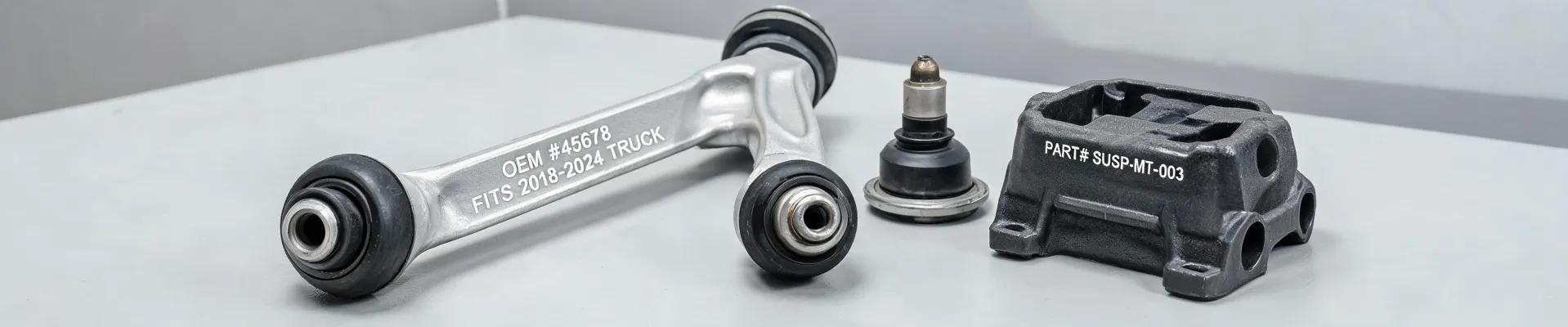
Whether you're designing leveling struts, exhaust pipe tips, CNC-machined housings, or forged suspension links, the same principle applies: value over price. The part that fails costs more than the part that works.
The next time someone asks about rn11yc4 spark plug threads or says "can a bad ignition coil cause a misfire"—well, that's not my area. I'm a procurement guy, not a mechanic. But when they need the metal components that make those assemblies possible? That's where I live.
And I've learned that the cheapest path is almost never the cheapest destination.

Elise Novak
Elise Novak is an automotive braking systems analyst specializing in brake pads, discs, rotors, calipers, shoes, drums, hoses, and complete brake kits. She uses UN Regulation 90 requirements and ISO 26867 dynamometer methods to examine friction stability, fade and recovery, wear, disc thickness variation, runout, and hydraulic integrity. Her work helps distributors, quality teams, and fleet buyers compare replacement parts, verify application suitability, and define incoming-inspection criteria.
Leave a sourcing comment